
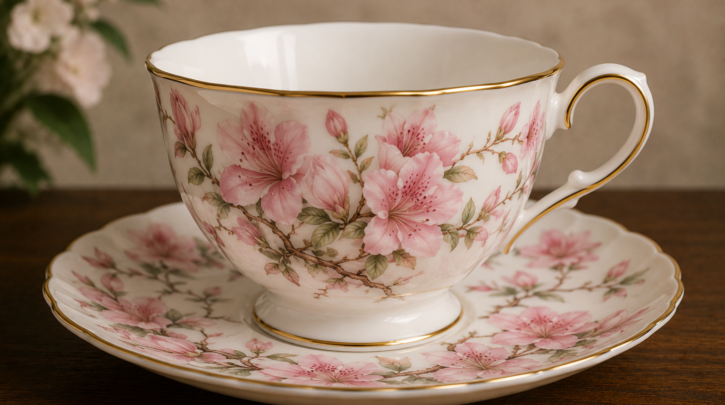

Noritake occupies a genuinely unusual position among the makers covered on this site: a company whose earliest documented export production falls squarely within the Nippon era, yet one that remained in active dinnerware production for the following century rather than existing as a purely historical name.
Noritake and the Nippon Era
Noritake was among the Japanese porcelain exporters producing wares marked “Nippon” for the American market between 1891 and 1921, before the mark changed to “Japan” following the 1921 customs ruling; see our Nippon marks guide for the full history of that specific thirty-year marking window this early Noritake production falls within.
A Maker That Kept Evolving
Unlike some names collectors associate purely with a single historic era, Noritake continued as a major, active dinnerware producer well beyond the Nippon period, which means Noritake pieces span an unusually wide range of eras, marks, and design styles compared to makers whose production effectively stopped decades ago.
Noritake Azalea: A Specific Sought-After Pattern
Among Noritake’s many patterns, Azalea stands out as a specifically recognized, sought-after design, with complete sets in good condition commanding real collector interest — worth knowing this specific pattern name if you’re trying to identify or complete a Noritake set.
Reading Noritake Marks Across Different Eras
Because Noritake’s marks changed meaningfully across its long production history, from early Nippon-era marks through various later 20th-century backstamps, confirming which specific era a mark belongs to matters more for Noritake than for makers with a shorter or more static production history; see our reading backstamps guide for the general process worth applying carefully to any Noritake piece.
Value Varies Enormously Across Noritake’s Catalog
Given how much Noritake’s output spans from genuinely rare, hand-painted early Nippon-era pieces through to much more common later mass-market dinnerware, value varies enormously within the Noritake name alone — worth avoiding any assumption that a Noritake mark by itself implies a consistent value tier; see our value guide for the general framework that applies once a specific era and pattern are confirmed.
Finding and Completing a Noritake Set
Because Noritake produced such a wide range of patterns across such a long period, finding a specific piece to complete an inherited or partial set benefits from a dedicated pattern search rather than general browsing.
Search Noritake patterns to complete a set Search Noritake at Replacements, Ltd.
A Genuinely Good Case Study in Mark Evolution
Because Noritake’s own history spans the Nippon era through decades of subsequent production, working through a Noritake piece’s mark carefully is a genuinely good practical exercise in applying the country-of-origin and general backstamp reading frameworks covered elsewhere on this site to a single, long-running maker.
Noritake Today
Unlike many names covered on this site whose production effectively ended decades ago, Noritake remains an active company, which means a Noritake mark alone doesn’t automatically signal an antique piece the way a mark from a long-defunct maker would — confirming era through the specific mark style and country wording matters more here than for most other makers covered on this site.
A Practical Approach for Noritake Owners
Starting with the mark to establish a rough era, then checking whether the specific pattern matches a recognized name like Azalea, gives a reasonable first pass at understanding what an inherited Noritake piece or set actually represents before deciding how much further research or professional appraisal is worth pursuing.
Beyond Azalea: Other Recognized Noritake Patterns
While Azalea is among the most consistently recognized and sought-after Noritake patterns, the company produced hundreds of additional patterns across its long history, many with their own smaller but genuine collector followings — worth researching a specific unfamiliar pattern name rather than assuming it lacks value simply because it isn’t as widely known as Azalea.
Hand-Painted vs. Transfer-Printed Noritake
Especially within the earlier Nippon-era production, genuinely hand-painted pieces command real premiums over transfer-printed decoration applied more mechanically — examining decoration closely under good light for the subtle variation and brushwork characteristic of hand-painting helps distinguish the two.
This distinction alone can meaningfully change how a specific piece should be valued.