
Wedgwood holds a genuinely unique place in British ceramics history as England’s oldest continuously operating pottery, founded by Josiah Wedgwood in 1759 and still producing fine china today — a span of operating history few manufacturers in any collectible category can match.
Jasperware: The Iconic Wedgwood Signature
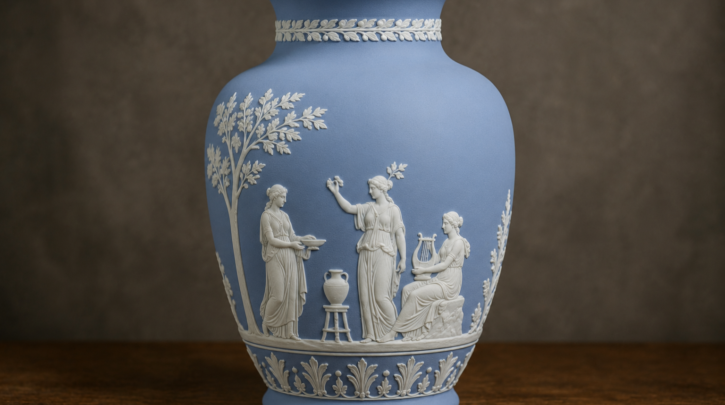
Jasperware, a distinctive matte stoneware most recognizably produced in a pale blue with contrasting white relief decoration, remains the single most iconic product associated with the Wedgwood name — instantly recognizable even to people with no other background in ceramics history.
Creamware and Bone China
Beyond Jasperware, Wedgwood built substantial product lines in creamware, an earlier lighter earthenware, and bone china, the finer, more translucent body that became the standard for high-end English tableware — worth recognizing that Wedgwood’s output spans several genuinely distinct material categories rather than consisting entirely of the famous blue-and-white Jasperware.
Wedgwood’s Three-Letter Date Code System
Wedgwood used a genuinely precise internal date coding system — two letters indicating the year and a third indicating the month — that reliably dates pieces produced between 1860 and 1930, giving collectors a level of dating precision most makers simply don’t offer; see our reading backstamps guide for how to spot and interpret maker-specific date codes like this one alongside a piece’s other markings.
Fairyland Lustre: Among the Most Valuable British China
Designed by Daisy Makeig-Jones and produced between 1915 and 1931, Fairyland Lustre pieces are widely regarded as among the most valuable British china ever made — richly detailed, fantastical scenes rendered in genuinely striking lustre glazes that set this line apart from anything else in Wedgwood’s broader catalog.
Wedgwood vs. ‘Wedgewood’
The extra “e” matters enormously — genuine Wedgwood spells its name without a middle “e,” and pieces marked “Wedgewood” come from other, unrelated manufacturers trading on the similarity rather than genuine Wedgwood production; see our marks identification guide for why small spelling differences like this one carry real weight in pottery identification generally.
Country-of-Origin Marks on Wedgwood
Because Wedgwood exported extensively to the American market, the same country-of-origin dating framework that applies broadly across pottery applies here too; see our country-of-origin dating guide for how “England” versus “Made in England” wording narrows down a Wedgwood piece’s approximate age.
Finding and Completing a Wedgwood Set
Given Wedgwood’s long production history and the sheer number of patterns produced across nearly three centuries, finding a specific piece to complete an existing set is a genuinely common need among Wedgwood owners.
Search Wedgwood patterns to complete a set Search Wedgwood at Replacements, Ltd.
Wedgwood’s Place Among British Makers
Alongside Royal Doulton, Spode, and other major English potteries, Wedgwood represents one of the handful of names most collectors of British china will encounter repeatedly, and its distinctive Jasperware look makes it one of the easier major makers to recognize on sight, even before checking a mark.
A Maker Worth Learning First
Given the combination of a genuinely long, well-documented history, a precise internal dating system, and instantly recognizable signature products, Wedgwood is a genuinely reasonable maker for a new collector of British china to study first, since the skills built researching Wedgwood transfer directly to researching other English potteries.
Caring for Jasperware Specifically
Jasperware’s matte, unglazed surface behaves differently from glazed china when it comes to cleaning — the porous surface can absorb oils and stains more readily than a glossy glazed piece, which is worth keeping in mind and handling with clean, dry hands rather than treating it identically to glazed tableware; see our cleaning guide for material-specific care across different pottery types.
A Note on Wedgwood’s Broader Influence
Josiah Wedgwood is often credited with genuinely innovative marketing and production techniques that influenced the broader pottery industry well beyond his own company’s output — his approach to documenting and standardizing production quality helped establish norms that other makers would later adopt, part of why Wedgwood’s historical significance extends beyond just the specific pieces the company produced.
Modern vs. Antique Wedgwood
Because Wedgwood remains in production today, not every Wedgwood-marked piece is antique — confirming era through the specific mark style, date code where present, and country wording matters for distinguishing a genuinely old piece from recent production carrying the same historic name.
Getting this distinction right protects against paying antique-level prices for contemporary production.