
Trademark protection doesn’t last forever, and pottery collecting runs straight into that fact more than most categories. When a company’s trademark on a name or mark lapses — through dissolution, non-renewal, or simple abandonment — that mark generally falls into the public domain. Nobody owns it anymore, which means nobody can stop an importer from legally stamping a brand-new piece with it. “Roseville” is the clearest example: the trademark has expired, and reproduction pieces bearing period-style Roseville backstamps have circulated for years, made and sold entirely within the law.
That single legal fact changes how you have to evaluate a mark. For a maker with a live, actively enforced trademark, an obviously wrong mark is a strong red flag almost by itself — the company has a legal incentive to go after counterfeiters, which keeps blatant fakes relatively rare. For a maker with an expired trademark, that enforcement pressure simply doesn’t exist. A mark can look completely correct — right words, right general shape, right placement — and still belong to a piece made decades after the original factory closed. The mark alone stops being reliable evidence, which means the piece itself has to do the talking.
Why the Mark Alone Isn’t Enough
Once you accept that a technically accurate-looking mark can appear on a piece with no real connection to the original factory, the practical question changes from “does this say Roseville” to “does this match what a genuine piece from that era actually looks and feels like.” That comparison comes down to three things worth checking on every piece where a mark carries real premium value: the letter shape and slant of the mark itself, the glaze texture immediately around it, and the wear pattern on the unglazed base. See our Roseville Pottery Guide for maker-specific reference points if that’s the mark in question.
Letter Shape and Slant
Genuine marks from a specific factory and era were typically applied with consistent tooling or stamps, which means the letterforms across documented genuine examples tend to match closely — same basic slant, same proportions, same spacing between letters. Reproductions are often close but not identical: a slightly different slant angle, letters that are a touch too uniform or too irregular compared to the genuine article, or spacing that doesn’t quite match. This is a comparison, not a standalone test — it only works if you’ve looked at several confirmed genuine examples first. See our guide to reading a pottery backstamp for the baseline mark-reading skills this builds on.
Glaze Texture Around the Mark
How glaze sits around an impressed or incised mark tells you something about the production process behind it. On a genuinely old piece, glaze typically settled into the recessed lettering during firing in a way that looks natural and slightly uneven under close inspection. Reproductions sometimes show glaze that pools unusually thick right at the mark, sits unnaturally uniform across the whole recessed area, or has a slightly different sheen than the surrounding glaze — small details, but ones that are hard to fully replicate without matching the original factory’s exact glaze formula and firing process.
Unglazed Base Wear Pattern
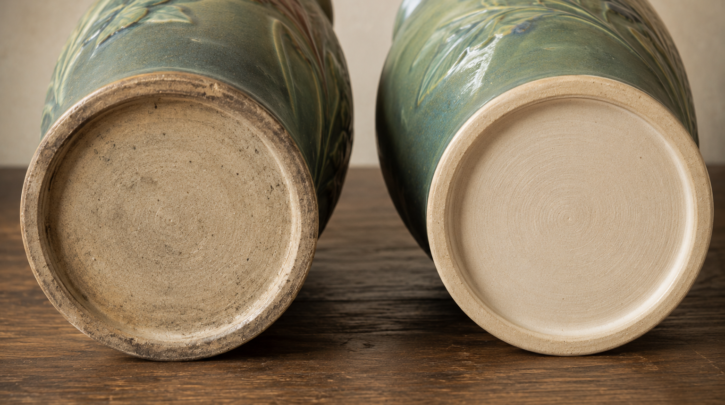
The unglazed foot ring or base of a piece is one of the most honest surfaces on it, because it’s the part that actually touched shelves, tables, and cabinets for however many decades the piece has existed. A genuinely old piece typically shows a base that’s dusty, slightly worn, or has picked up a faint patina consistent with real handling and display over time. A base that’s suspiciously clean, uniformly pale, or shows no wear at all on a piece claimed to be many decades old is worth real scrutiny — it’s one of the harder things for a reproduction to convincingly fake, since manufactured “aging” tends to look different from wear that happened gradually and unevenly over real time.
Fake or Added Marks
Separate from whole-piece reproductions, a fake or added backstamp is sometimes applied to an otherwise unmarked or lesser piece, intended to let a seller charge premium prices for something that isn’t what it claims to be. This is a genuine, recurring concern across pottery collecting, and the same letter-shape, glaze-texture, and base-wear checks apply here too — an added mark often sits slightly wrong relative to the piece’s actual glaze and firing history, even when the piece itself is old.
How to Spot an Added Mark
A genuine factory mark, whether impressed, printed, or painted, shows consistent depth, placement, and style that matches documented genuine examples. A mark added later, by contrast, often shows inconsistent depth, an unusual glaze relationship around the mark relative to the rest of the piece, or lettering that doesn’t quite match verified genuine examples from the same maker and era.
Nippon Marks: A Specific, Common Target
Given the real price premium genuine Nippon-marked porcelain commands, this specific mark is a particularly common target for reproduction and outright fakery — and it follows the same underlying pattern, since “Nippon” stopped being required on Japanese exports after 1921, leaving decades of open territory for the mark to be applied inconsistently. See our Nippon marks guide for the specific detection principles worth applying before paying Nippon-era prices for anything.
Weight and Clay Body Inconsistencies
A piece that feels noticeably lighter or heavier than expected for its size and claimed maker, or whose clay body color and texture doesn’t match documented genuine examples, deserves extra scrutiny. These physical checks work best as supporting evidence alongside the mark, glaze, and base checks above rather than as a standalone test on their own.
Being Skeptical of Too-Good-to-Be-True Prices
A piece from a recognized valuable maker priced dramatically below what comparable confirmed genuine examples command deserves real scrutiny before purchase — either the seller is unaware of genuine value and offering a real bargain, or something about the piece’s authenticity doesn’t hold up, and it’s worth confirming which before assuming the former.
Run the Quick Checks Before You Buy
Our free 5-Second Pottery Mark Dating Checklist covers the fastest dating and authentication tells, sized to actually use while you’re examining a piece before a purchase.
Buying From Reputable Sources
Buying from established dealers with a track record in the specific category you’re pursuing, or from sellers active in dedicated collector communities, meaningfully reduces risk compared to an anonymous listing with no reputation history behind it, particularly for a significant purchase. Venue matters here as much as the checks themselves — see our guide to where to buy antique pottery for how different venues stack up on exactly this kind of risk.
When in Doubt, Get a Second Opinion
For any purchase where the price assumes genuine, valuable maker attribution, getting a second opinion from an experienced dealer or collector before committing is worth the extra effort — the cost of verification is almost always smaller than the cost of being wrong.
Building a Personal Reference
Photographing verified genuine marks, glaze detail, and base wear on pieces you’ve handled or purchased builds a personal reference that becomes genuinely useful whenever a new piece raises a question — the same approach that pays off across every collectible category covered on this site. If you’re the one selling rather than buying, the same documentation habit works in your favor: our guide to selling antique pottery covers how to put these same details to work in a listing.
A Final Word on Due Diligence
None of these individual checks is foolproof on its own, but running through mark shape, glaze character, and base wear together on any purchase where maker attribution meaningfully affects price catches the overwhelming majority of misrepresented pieces before any money changes hands.
Trusting the Process as You Learn
It’s normal to feel uncertain early on, especially given how much money can be at stake with a genuinely rare piece — that uncertainty fades with repeated practice examining genuine marks and pieces, and staying appropriately careful is simply part of collecting responsibly rather than a sign anything is wrong with your approach.
Slowing down for these checks costs a few minutes and can save real money on the wrong purchase.