
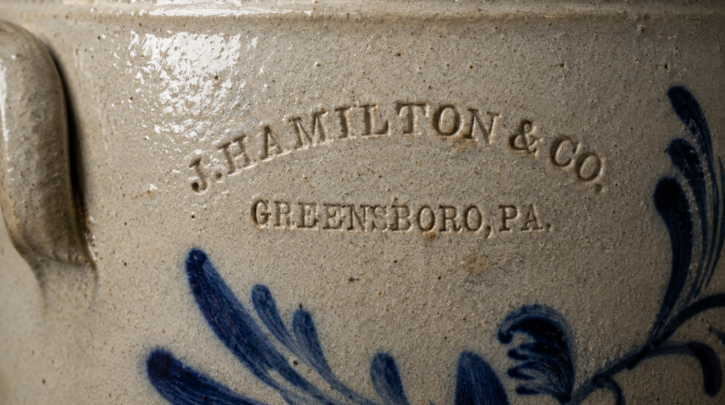

Reading a stoneware mark works differently from reading a fine china backstamp, both in how the mark was physically applied and in how much documentation exists for the maker behind it.
Impressed and Stamped Marks
Unlike the printed or painted marks common on fine china, stoneware marks were typically impressed or stamped directly into the wet clay before firing, usually showing the potter’s name and the location where the piece was made; see our marks identification guide for how this application method compares to the printed and painted marks common on other pottery categories.
Marks Alongside Cobalt Decoration
A maker’s mark sometimes appeared alongside the cobalt decoration itself, either incorporated into the decorative design or stamped separately nearby — worth checking the entire visible surface of a piece rather than assuming a mark, if present, will appear in one predictable location.
Many Regional Potteries Left Minimal Documentation
Compared to fine china manufacturers, many smaller regional stoneware potteries left considerably less surviving business documentation, which genuinely makes some stoneware harder to research with confidence than more thoroughly documented fine china from major manufacturers; see our unmarked pottery identification guide for how to approach identification when documentation is genuinely limited.
Attribution Through Form and Decoration
When a maker’s mark is missing, worn, or simply never existed, comparing a piece’s form, glaze character, and decorative style against documented regional conventions becomes the primary identification tool; see our regional American potteries guide for the broader regional framework this kind of attribution work relies on.
A Dedicated Collector Literature Exists
Despite the documentation challenges around many smaller potteries, a genuine, dedicated body of collector reference literature and community expertise exists specifically for American stoneware, distinct from general fine china reference material — worth seeking out these stoneware-specific resources rather than relying on general pottery references alone.
Confirming a Mark’s Authenticity
Because certain regional potteries and specific decorative motifs command real premiums, comparing an unfamiliar mark’s exact wording, letterforms, and impression depth against verified genuine examples helps confirm authenticity before assuming a piece traces back to a specific well-regarded maker.
Building a Personal Reference
Photographing confirmed genuine marks you’ve handled or researched builds a personal reference collection that becomes genuinely useful the next time an unfamiliar stoneware mark turns up, since side-by-side comparison is often the fastest way to confirm or rule out a specific maker.
Marks as a Starting Point, Not a Complete Answer
Even a confirmed genuine maker’s mark typically answers only who made a piece and roughly where, leaving questions about specific production date, decorator, and rarity that require further research into that particular pottery’s own documented history; see our value guide for the other factors worth researching once a maker is confirmed.
A Genuinely Different Research Experience
Researching stoneware marks and makers feels meaningfully different from researching fine china backstamps — less about matching a printed logo against a definitive published reference, and more about building genuine regional and historical knowledge over time, which is part of what makes stoneware collecting such a distinct hobby within the broader world of pottery collecting.
Working With Fragmentary Information
Accepting that some pieces will only ever have a partial, best-guess attribution — a likely region and rough era rather than a confirmed named maker — is a normal, healthy part of stoneware collecting rather than a research failure, given how much documentation genuinely didn’t survive for many smaller potteries.
Family Potteries and Generational Marks
Some stoneware potteries operated as genuine family businesses across multiple generations, sometimes with marks that changed subtly as leadership passed from one family member to the next — worth checking whether small mark variations you notice reflect this kind of generational transition rather than assuming every variant mark represents a completely different, unrelated company.
A little extra caution here avoids drawing overly confident conclusions from what might just be a minor mark variation.