
Lenox stands as America’s preeminent fine china maker, with a history that traces back to the Ceramic Art Company before the Lenox name itself came to define high-end American tableware.
From Ceramic Art Company to Lenox
Lenox began as the Ceramic Art Company, generally abbreviated CAC in mark research, before formally becoming Lenox in 1906 — genuine early CAC-marked pieces from this predecessor era are specifically recognized and valued by collectors as a distinct, earlier category within the company’s overall output.
Why Pre-1906 CAC Pieces Are Specifically Valuable
Because the CAC era represents the company’s earliest, most limited production before it grew into the large-scale operation the Lenox name would later represent, confirmed pre-1906 CAC pieces generally command a real premium over later Lenox-marked production of comparable quality and form.
A Distinctive Ivory-Toned Bone China
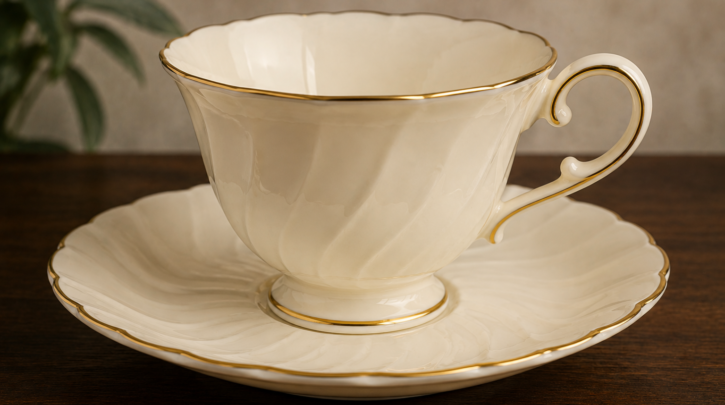
Lenox built much of its reputation around a distinctive warm, ivory-toned bone china, genuinely different from the brighter, cooler white favored by some European competitors — a recognizable house characteristic that experienced collectors learn to identify by look and feel alone.
White House China
Lenox holds a genuinely significant place in American decorative arts history as a supplier of official White House china for multiple presidential administrations — a distinction that speaks directly to the company’s standing at the very top of American fine china production.
Reading Lenox Marks
Lenox marks generally include the company name alongside a pattern name or number, following the same general backstamp-reading principles that apply across fine china broadly; see our reading backstamps guide for the step-by-step process worth applying to any Lenox piece.
As an American Maker, Different Dating Rules Apply
Because Lenox is a domestic American manufacturer rather than an importer, the McKinley Tariff Act’s country-of-origin marking requirements, which apply specifically to imported goods, don’t govern Lenox dating the way they do for European or Japanese imports; see our country-of-origin dating guide for why this distinction matters when dating a domestic maker versus an imported one.
Finding and Completing a Lenox Set
Given how many Lenox patterns have been produced across the company’s long history, and how often Lenox china was chosen specifically as wedding or heirloom china meant to be passed down, finding pieces to complete an inherited or incomplete set is a genuinely common need.
Search Lenox patterns to complete a set Search Lenox at Replacements, Ltd.
Lenox as an American Counterpart to English Bone China
Lenox occupies roughly the same position in American fine china that makers like Wedgwood or Royal Doulton occupy in British ceramics — the recognized top-tier domestic name most collectors of American china will encounter first, which makes it a genuinely reasonable starting point for anyone specifically interested in American rather than European fine china.
Assessing an Inherited Lenox Set
For an inherited Lenox set, checking for a CAC-era mark specifically before assuming standard later-era value is worth doing early, since that one detail meaningfully shapes both the set’s value and how it should be researched further; see our reading backstamps guide for the general process worth applying to confirm exactly which era a specific mark belongs to.
Lenox’s Consistency Across Patterns
While specific patterns and decorative styles varied considerably across Lenox’s long history, the underlying ivory-toned bone china body itself remained remarkably consistent, which means the material feel of a piece is a genuinely useful supporting check alongside the mark when confirming Lenox against a similar-looking competitor’s product.
Lenox Beyond Dinnerware
Beyond formal china sets, Lenox produced a broad range of decorative and gift items over its history, including vases, decorative boxes, and holiday ornaments — worth recognizing that a Lenox-marked piece isn’t necessarily part of a formal dinnerware pattern at all, and identifying which product category you’re looking at matters before searching for matching pieces.
Lenox and American Wedding Registries
For much of the 20th century, Lenox held a genuinely dominant position as the default choice for formal wedding china among American brides, which explains both why so much Lenox china survives in circulation today and why completing an inherited or partial Lenox set is such a commonly searched need.
That enduring popularity is part of why Lenox remains one of the most consistently searched names among American china collectors today.