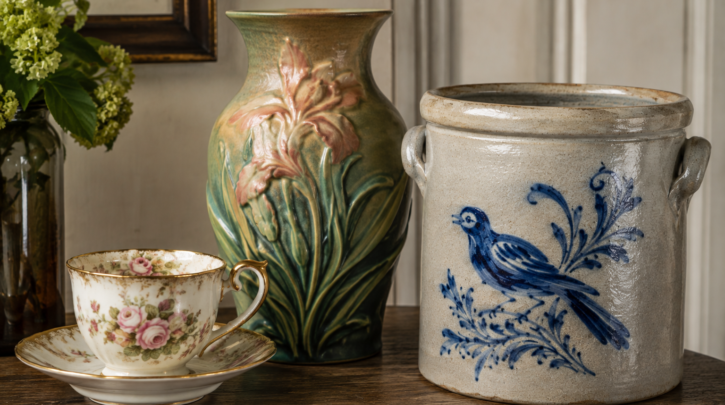

Whether you’re holding fine china, American art pottery, or a piece of utilitarian stoneware, the same core factors determine value — maker, condition, rarity, decoration quality, and dating confidence — even though the weight each factor carries shifts considerably depending on what category you’re actually looking at.
Maker and Attribution
Confirming who made a piece, whether through a documented backstamp or careful physical attribution, is the foundation everything else builds on — see our marks identification guide and unmarked pottery identification guide for the two starting points depending on whether a piece carries a mark at all.
Condition
Chips, cracks, glaze damage, and repairs all reduce value, and the impact varies by category — crazing affects some pieces more than others, while a chip on a purely decorative art pottery vase matters differently than the same damage on a stoneware crock built for hard daily use; see our care guide for how proper handling protects condition over the long term.
Rarity of Form, Pattern, or Line
Beyond the maker alone, unusual forms, rare named lines, and short-production patterns command real premiums within an otherwise common maker’s catalog — worth researching a specific piece’s documented rarity rather than assuming age alone signals scarcity; see our maker-specific guides across this site for how this plays out for individual companies.
Decoration Quality and Artist Attribution
Hand-painted, individually credited decoration generally commands stronger value than mass-produced or transfer-printed decoration, particularly within American art pottery, where named decorators sometimes developed their own dedicated collector followings; see our Rookwood pottery guide for a well-documented example of how individual artist attribution affects value.
Dating Confidence Adds Real Value
A piece with clear, confidently dated marks — whether through country-of-origin wording, a maker’s precise date code, or a decoded registration number — generally commands more buyer confidence, and therefore often a stronger price, than a similar piece with genuinely uncertain dating; see our country-of-origin dating guide for the single most widely applicable dating tool covered on this site.
Completeness Matters for Dinnerware Specifically
For fine china and dinnerware, a genuinely complete, matching set is worth considerably more than the same pieces sold individually, since assembling a complete set piece by piece takes real time and effort a buyer is often willing to pay a premium to skip — a dynamic that matters far less for art pottery or stoneware, where pieces are typically valued individually rather than as part of a matched service.
When to Get a Professional Opinion
For a large, uncertain, or potentially valuable collection, a professional appraisal is worth the cost before selling, insuring, or making any irreversible decision; see our reproductions and fakes guide for the specific authentication concerns worth understanding before any significant purchase or sale.
Value Beyond Resale
Knowing a realistic value matters even without any plan to sell — for insurance purposes, for deciding how carefully to display or store a piece, and simply for understanding what’s actually in a family collection passed down without any record of what it’s worth.
A Grounded Way to Assess a Collection
For anyone assessing an inherited or accumulated collection for the first time, start by confirming maker and identifying pattern or line, noting condition issues, then check recent completed sales for comparable pieces before assuming either that everything is worthless or that every piece commands a major premium — the honest reality for most collections sits somewhere in between.
Documenting a Collection Over Time
Keeping photos and notes on each piece’s maker, pattern or line, and condition, alongside whatever price research you’ve done, creates a useful running record whether you eventually sell, insure, or simply want to understand what a family collection actually contains.
That balanced approach protects against both under-selling a genuine rarity and over-insuring a box of common pieces.