
Rookwood Pottery is widely regarded as the pioneering company of the American art pottery movement, founded in Cincinnati, Ohio in 1880 by Maria Longworth Nichols and built into a genuinely internationally recognized name within just two decades.
International Recognition
Rookwood’s reputation wasn’t just a domestic story — the company won a gold medal at the 1900 Paris Exposition, a genuinely significant international achievement that helped establish American art pottery as a serious artistic movement rather than a purely regional craft tradition.
The Rookwood Standard Glaze
Much of Rookwood’s early reputation rests on its Standard glaze, a rich, glossy finish typically in warm brown and amber tones, applied over hand-painted underglaze decoration — florals and natural motifs were especially common, rendered with genuine artistic skill rather than the more mechanical decoration typical of mass-market pottery.
Later Matte Glaze Lines
As the company’s aesthetic evolved, Rookwood developed various matte glaze lines alongside its glossy Standard glaze work, broadening the range of finishes collectors now associate with the Rookwood name across different eras of the company’s production.
The Flame Mark: One of the Most Precise Dating Systems
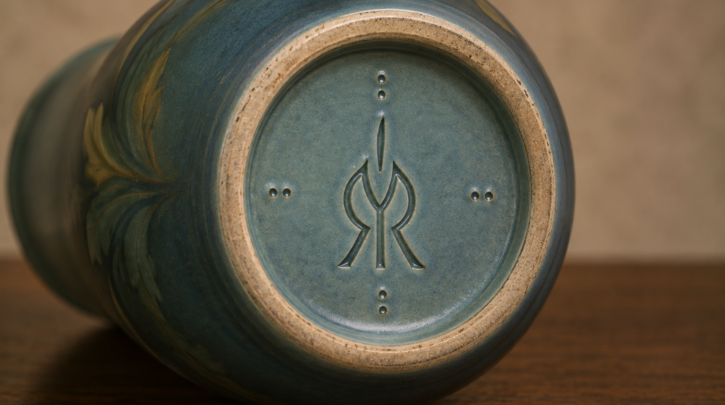
Rookwood’s distinctive mark — a stylized flame formed from a reversed and mirrored “R” and “P” — is surrounded by a genuinely systematic dating mechanism, with dots or additional flame marks added around the base logo that can be counted to determine a specific production year, making it one of the most precise, reliable dating systems in all of American pottery; see our reading backstamps guide for the general principle of maker-specific date codes this system exemplifies particularly well.
Shape and Size Numbers
Alongside the flame mark and its date-indicating elements, Rookwood pieces typically carry separate shape and size numbers, giving collectors yet another layer of documented, cross-referenceable production detail beyond just the date alone.
Individual Decorator’s Marks
Because Rookwood’s decoration was substantially the work of individually credited artists rather than anonymous factory labor, many pieces carry the decorator’s own initials or monogram alongside the factory mark — identifying which specific artist decorated a piece can meaningfully affect its value, since some decorators developed their own dedicated collector followings.
Finding Rookwood Pieces
Given the combination of documented dating precision, artist attribution, and genuine historical significance, Rookwood pieces are actively sought by a dedicated collector base across a wide range of buying channels.
Search current Rookwood listings Search Rookwood pottery on eBay
Rookwood’s Influence on the Broader Movement
Because Rookwood established many of the artistic and commercial conventions that other American art potteries would later follow, understanding Rookwood’s history genuinely helps contextualize the broader movement it helped launch; see our Roseville pottery guide and Weller pottery guide for two of the other major names that emerged within this same broader American art pottery tradition.
A Genuinely Rewarding Maker for Serious Study
Given the combination of documented dating precision, credited artist attribution, and a well-preserved company archive that collectors and researchers continue to draw on, Rookwood rewards genuinely deep study more than almost any other maker covered on this site.
Preserving Rookwood’s Documented History
Because Rookwood kept genuinely detailed production records, researching a specific piece against the company’s own archival documentation, where accessible, can sometimes confirm details — exact decorator, precise production context — that go well beyond what the mark alone reveals, a level of documentation depth rarely available for other makers.
Rookwood’s Later Corporate History
Like many long-running potteries covered on this site, Rookwood went through real ownership and operational changes over the decades following its original founding era, which is worth keeping in mind when researching a piece’s exact production context beyond just the flame-mark date — the company that produced a piece in a later decade wasn’t necessarily operating under identical circumstances to the founding-era company.
A Piece Worth Handling in Person When Possible
Photographs alone struggle to capture the genuine depth and richness of Rookwood’s glazes, particularly the Standard glaze’s characteristic warmth — seeing and handling confirmed genuine pieces in person, at a show or through a specialist dealer, builds an appreciation that’s hard to develop from images alone.