
Stoneware crocks were made for genuinely practical purposes — storing pickles, sauerkraut, butter, and other household provisions — yet the decorative cobalt work many potters added to these purely functional vessels has made them one of the most recognized American folk art traditions in antique collecting today.
Purely Functional Origins
Before refrigeration, stoneware crocks served as essential household and farm storage vessels, valued for their durability and the way their dense, non-porous body kept contents fresh — worth remembering that these were everyday working objects first, not originally created as decorative art.
Cobalt Blue Decoration: The Defining Feature
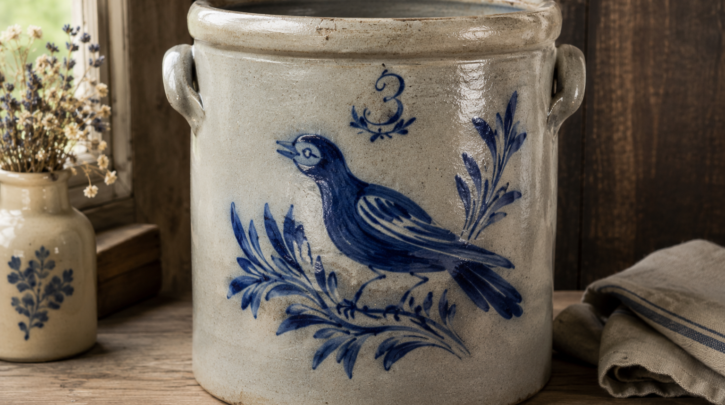
Hand-applied cobalt oxide slip, painted directly onto the unfired clay before glazing, is the single most recognizable feature of American stoneware — flowers, birds, geometric patterns, and sometimes the maker’s own name and location were rendered in this distinctive blue, turning a working vessel into a genuine piece of folk art in the process.
Capacity Numbers
Numbers marked on a crock — often a simple “1,” “2,” or higher — indicate gallon capacity, a genuinely practical marking rather than a decorative one, though these numbers now double as a useful size reference for collectors comparing pieces today.
Bird and Floral Motifs Command Real Premiums
Within the broad category of cobalt decoration, certain motifs command considerably more collector interest than others — elaborate, fully realized bird designs, particularly detailed eagles, generally command meaningfully stronger prices than simpler floral or geometric decoration, reflecting genuine artistic ambition on the part of the original decorator.
Handle Construction
Larger crocks and jugs typically feature applied “ear” or strap handles, formed separately and attached to the body before firing — a genuine construction detail worth examining, since handle style and attachment method can offer supporting clues when trying to date or attribute an unmarked piece.
Reading a Stoneware Mark
When present, a maker’s mark on stoneware was typically impressed or stamped directly into the clay, often showing the potter’s name and location; see our stoneware marks and makers guide for how these marks differ from the printed backstamps common on fine china.
The Salt-Glaze Technique Behind Many Crocks
Much American stoneware, including many crocks, was finished using salt glazing, a distinctive traditional technique worth understanding on its own terms; see our salt glaze stoneware guide for how this specific glazing method worked and what it looked like.
Finding Antique Stoneware Crocks
Given how widely these vessels were produced and used across rural and urban households alike, stoneware crocks remain genuinely accessible to find, though pieces with elaborate cobalt decoration require more patient, targeted searching.
Search current stoneware crock listings Search stoneware crocks on eBay
Condition Considerations Specific to Crocks
Because these vessels were genuinely used for decades of hard household or farm work, chips along the rim, hairline cracks, and general surface wear are all extremely common — worth weighing condition honestly against decoration quality rather than expecting pristine survival on a piece that spent its working life doing exactly the hard job it was made for.
Regional Attribution for Unmarked Crocks
Many crocks carry no maker’s mark at all, which means clay color, form, and decorative style become the primary identification tools rather than a stamped name; see our regional American potteries guide for how different regions developed distinct enough characteristics to support this kind of attribution.
Jugs vs. Crocks: Related but Distinct Forms
Jugs, with their narrower necks designed for pouring liquids, and crocks, with their wider open tops designed for storing solids or semi-solids, represent two genuinely distinct forms within the same broader utilitarian stoneware tradition — both often carry similar cobalt decoration and capacity markings, but collectors sometimes specialize in one form over the other.
Churns as a Related Form
Butter churns represent yet another related utilitarian stoneware form, typically taller and narrower than a storage crock and sometimes marked with dash marks indicating churn dasher positioning — worth recognizing as its own distinct form within the broader utilitarian stoneware family covered on this site.
A Genuinely Approachable Entry Point
Common, undecorated or simply marked stoneware crocks remain genuinely affordable and widely available, making this a reasonable starting category for a new collector to build handling experience and identification confidence before pursuing rarer, elaborately decorated pieces.