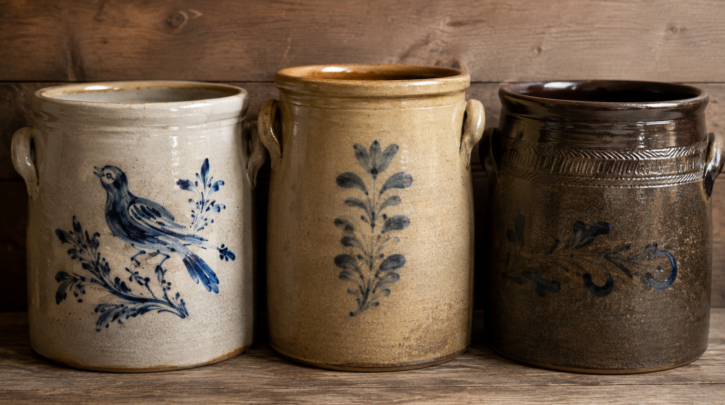

American stoneware production wasn’t a single uniform national industry — different regions developed genuinely distinct traditions, shaped by local clay sources, available transportation, and regional decorative conventions that experienced collectors learn to recognize.
Local Clay Sources Shaped Regional Character
Stoneware clay wasn’t uniform across the country, and different regional clay deposits produced genuinely different color and texture characteristics in the finished body — a real, physical difference that contributes to regional attribution alongside decorative style and form.
New York, New Jersey, and Pennsylvania
The mid-Atlantic region, including New York, New Jersey, and Pennsylvania, developed into a genuine historic center of American stoneware production, helped along by transportation infrastructure like the Erie Canal that made distributing heavy, bulky stoneware vessels considerably more practical across a wider market.
Transportation Access Shaped the Industry
Because stoneware is heavy and genuinely expensive to ship over land, access to water transportation — canals, rivers, and later railroads — meaningfully shaped which regional potteries grew into large-scale operations versus which remained smaller, purely local producers serving a limited nearby market.
New England Traditions
New England developed its own stoneware tradition alongside the mid-Atlantic centers, with regional variations in form and decoration that a trained eye learns to distinguish from mid-Atlantic or later Midwestern production.
Later Midwestern Production
As American settlement and industry expanded westward, Midwestern stoneware production, including the Ohio region already significant for American art pottery, developed its own later chapter in this broader story; see our Rookwood pottery guide for one example of how this same general region later became significant for art pottery specifically, a genuinely different but related chapter in American ceramic history.
Why Regional Attribution Matters for Unmarked Pieces
For stoneware without a surviving maker’s mark, comparing clay color, form, and decorative style against documented regional conventions is often the most productive identification approach available; see our unmarked pottery identification guide for the general principles this kind of regional attribution work builds on.
Building Regional Knowledge Over Time
Handling and comparing confirmed genuine pieces from different documented regions, ideally side by side, builds the kind of practiced eye that can eventually recognize regional characteristics quickly — a skill that develops gradually rather than something learned from a single reading of any guide.
Regional Knowledge Supports Value Assessment Too
Beyond pure identification, confirming a piece traces to a specific well-documented regional pottery, particularly one known for skilled decorative work, can meaningfully support its value; see our value guide for how documented regional attribution factors into overall worth alongside decoration quality and condition.
A Genuinely Rewarding Area for Deeper Study
Regional American stoneware attribution rewards genuinely patient, comparative study more than almost any other identification skill covered on this site, since so much of the work relies on physical comparison rather than reading a definitive mark.
Migration of Potters and Techniques
Individual potters and entire families sometimes relocated over the course of their working lives, carrying techniques and stylistic preferences from one region to another — a genuine complicating factor worth remembering, since a piece showing characteristics of one region’s tradition doesn’t always mean it was actually made there.
Regional Study as Its Own Rewarding Specialty
Some collectors specifically focus their entire collecting interest around a single documented region or even a single historic pottery, building genuinely deep expertise in that narrow area rather than trying to cover American stoneware broadly — a completely legitimate and often more satisfying approach than attempting to become a generalist across every region at once.
Historical Societies and Local Museums as Resources
Local historical societies and regional museums, particularly in areas with documented historic pottery production, sometimes hold genuinely useful archival material and even example pieces that aren’t available through general collector reference guides — worth reaching out to these local institutions when researching a piece with a suspected connection to a specific documented region.
These local resources often hold details that never made it into broader, more general reference works.