
Where you buy antique pottery matters as much as what you pay for it — and for one reason collectors often overlook: trademark protection on a maker’s mark doesn’t last forever. Once a company’s trademark expires, there’s nothing stopping an importer from stamping a brand-new, Chinese-made piece with a mark that looks period-correct down to the glaze color. Roseville’s marks are a well-known example of this — the trademark has lapsed, and reproduction pieces bearing Roseville-style backstamps circulate widely. Our Roseville Pottery Guide and Pottery Reproductions & Fakes guide both cover this in more detail.
That single fact should shape how you shop. A mark alone can no longer tell you a piece is genuine — you also need to judge glaze quality, weight, mold crispness, and wear patterns, and none of that is possible from a thumbnail photo. So before price, selection, or convenience, the venue itself is your first line of reproduction defense: can you actually pick the piece up, tilt it under real light, and walk away if something feels off?
Why Venue Is Your First Line of Defense
Think of every place you might buy pottery as sitting somewhere on a spectrum, from “you can handle the piece and ask a specialist questions” to “you’re trusting a photo and a stranger’s description.” The closer a venue sits to the hands-on end, the easier it is to catch a reproduction before you pay for it — checking mold seams, comparing glaze pooling to known examples, or simply asking a dealer who specializes in the maker what they think. The farther a venue sits toward the sight-unseen end, the more that job shifts onto return policies, seller reputation, and your own reference knowledge doing the work after the sale instead of before it.
None of this means avoid online buying or only trust in-person sellers — it means matching how much scrutiny a piece needs to how much scrutiny the venue actually lets you apply.
High-Trust Venues: Specialty Pottery Shows and Dealer Booths
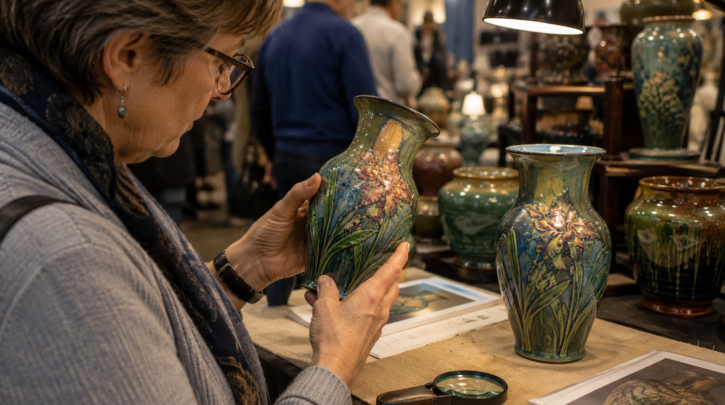
Specialty pottery and ceramics shows are close to the ideal venue for exactly this reason. Dealers who focus on a specific maker or era have usually handled hundreds of genuine pieces, which means they’ve also learned to spot the reproductions moving through the market for that same maker. Walking a show lets you compare five or six examples of the same pattern side by side, ask pointed questions about a specific mark, and get a straight answer from someone whose reputation depends on not selling fakes.
Dealer booths that offer a written return policy add a second layer of protection on top of that in-person inspection. If a piece turns out to have an issue you missed on the floor — a hairline crack, a mark that doesn’t quite match reference examples once you get it home under better light — a return policy gives you a way out that a casual private sale or a one-off online purchase usually doesn’t.
Antique Malls and Specialty Pottery Dealers
Antique malls sit a step down from dedicated pottery shows but still offer real hands-on inspection. Booth rents and dealer markup mean prices generally run higher than estate sale pricing, but you’re paying partly for that markup to include someone’s expertise — a good antique mall dealer specializing in art pottery or china will often flag a reproduction before you even ask. Use our guide to reading a pottery backstamp to do your own quick check alongside whatever the dealer tells you; two sets of eyes on a mark beat one.
Estate Sales
Estate sales often offer the best original pricing and a real chance at undiscovered rarities, because pricing is frequently set by someone without deep knowledge of pottery — a genuinely valuable piece can get priced as an ordinary decorative item simply because nobody checked the mark. Reproduction risk here tends to be lower than online buying for a different reason than expertise: most estate sale inventory is decades-old household pottery rather than recently imported stock, so the pool of items you’re choosing from skews genuinely old to begin with. Still, since you’re handling the piece directly, it costs nothing to run your own quick mark check before you pay.
Flea Markets
Flea markets are a genuine mixed bag — occasional real bargains alongside occasional misidentified pieces sold as more valuable than they actually are, or the reverse. This is also where you’re most likely to encounter reproduction stock mixed in with genuinely old pieces, sometimes without the seller even realizing it. Bringing solid identification knowledge matters more here than almost anywhere else; our country-of-origin dating guide is worth running through on the spot before you commit to a price.
Auctions
In-person auctions let you preview lots beforehand, which gives you the same hands-on inspection window as a dealer booth — take it seriously rather than skipping straight to bidding. Online auctions remove that inspection entirely and add the pressure of competitive bidding on top, which is a combination worth being cautious about for anything claiming to be a rare or high-value maker. Either way, setting a firm maximum price before bidding begins, and sticking to it regardless of how the bidding unfolds, is the single most useful discipline for auction buying.
Online Marketplaces: The Highest-Risk Venue
Online marketplaces offer by far the largest selection and the ability to search for a specific maker or pattern directly — but they’re also the venue where the expired-trademark problem bites hardest. A listing photo can’t show you glaze texture, mold weight, or the subtle wear a genuinely old piece accumulates, and a well-photographed reproduction can look convincing at thumbnail size. Treat online buying as the venue that needs the most reference-checking on your end: compare the mark against a reliable guide before bidding, ask the seller directly about crazing, repairs, and where the piece came from, and lean on buyer protection and return windows as your safety net rather than an afterthought.
Search antique pottery on eBay
Dedicated Pattern-Matching Services
For the specific task of finding a piece to complete or expand an existing dinnerware set, a specialist matching service is often faster and more reliable than searching general marketplaces piece by piece — and because these services deal in enormous volume of a narrow category, they tend to have strong internal expertise on spotting anything that doesn’t match genuine production runs for a given pattern.
Search patterns at Replacements, Ltd.
Collector Clubs and Specialty Societies
Dedicated collector communities — art pottery societies, stoneware collector groups, and china pattern communities — connect buyers directly with knowledgeable sellers who specialize in specific makers or categories. These communities are often the best source for rare finds and for expert opinions that rarely surface through general channels, and members tend to be quick to flag reproductions circulating for a given maker since it directly affects the value of pieces they already own.
A Reproduction Defense Checklist for Any Venue
- Check the mark closely and verify it against a reliable reference before assuming value in either direction — see our pottery marks identification guide for a starting point
- Examine condition under good light, checking specifically for crazing, chips, and repairs
- Ask about return policies before buying anything expensive sight unseen, especially online
- Research a maker or pattern before a big purchase rather than trusting a seller’s description alone — check our reproductions and fakes guide if the maker is one known for reproduction activity
- Weigh the piece in your hand when possible — reproductions are sometimes noticeably lighter or heavier than genuine examples from the same maker
Budgeting for the Hunt
Setting a rough budget before heading out to an estate sale or antique mall, and treating it as a genuine limit rather than a loose guideline, helps avoid the common pattern of overspending on impulse finds that don’t actually fit a collection’s focus. It also gives you a natural moment to pause and double-check a mark before committing, rather than getting swept up in the moment.
Building Relationships With Dealers
A dealer who gets to know your specific collecting interests over repeated visits will often set aside pieces or offer a heads-up before something goes on the general sales floor. This kind of relationship takes time to build, but it also compounds your reproduction defense over time — a dealer who knows what you collect learns what you’re worried about, and will often mention it unprompted if something looks off.
Timing Your Shopping
Estate sales typically offer the best selection on the first day but often reduce prices on later days to clear remaining inventory — a genuine tradeoff between selection and price worth weighing based on whether you’re chasing something specific or open to whatever turns out to be a good value.
Neither approach is wrong. What matters more than timing, in the end, is matching the venue to how much scrutiny a piece needs — save the sight-unseen convenience of online marketplaces for makers and patterns you already know well, and save your in-person inspection time for anything claiming to be rare, valuable, or from a maker whose marks are known to circulate on reproductions. If you’re building out a full collection rather than buying a single piece, our guide to building a pottery collection covers how to think about that balance over the long run — and when it’s time to part with a piece instead, see how to sell antique pottery.