
“Nippon” is simply the Japanese word for Japan, but on the bottom of a piece of porcelain, it functions as a remarkably precise dating tool — genuine Nippon marks were used for exactly thirty years, giving collectors one of the cleanest dating windows in the entire hobby.
Why Japanese Porcelain Was Marked ‘Nippon’
When the McKinley Tariff Act required country-of-origin marking on goods imported into the United States starting in 1891, Japanese porcelain exporters needed an English-legible way to indicate their country of origin, and they chose “Nippon,” their own name for Japan; see our country-of-origin dating guide for the broader legal framework this decision fits into.
The Exact Window: 1891 to 1921
A 1921 US customs ruling determined that “Nippon” no longer satisfied the legal requirement for English-legible country marking, and required “Japan” going forward instead — which means a genuine Nippon mark reliably dates a piece to that specific thirty-year window, one of the most precise dating tools available for any pottery category.
Design Evolution Within the Nippon Era
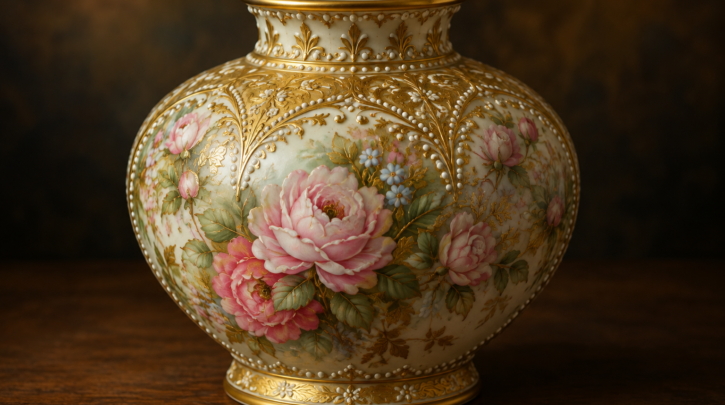
Even within this thirty-year window, Nippon porcelain shows a genuine stylistic evolution — early pieces from the 1890s into the early 1900s lean heavily into Victorian-era density, with heavy gilding and busy floral motifs like roses and violets, while later pieces move toward the more open, flowing lines associated with Art Nouveau design as the era progressed.
Nippon Commands a Real Collector Premium
Genuine Nippon-marked pieces generally sell for meaningfully more than comparable pieces marked “Japan” from just a few years later, reflecting genuine collector demand for the earlier, rarer window — a real price gap tied directly to this one specific dating detail.
Why Nippon Marks Are a Common Fake Target
Precisely because genuine Nippon pieces command this premium, the mark is a specific, common target for reproduction and fakery — worth extra scrutiny before paying Nippon-era prices for anything; see our reproductions and fakes guide for the broader detection principles worth applying here.
What Nippon Pieces Typically Depict
Nippon porcelain was designed specifically to appeal to American taste rather than traditional Japanese aesthetics — florals, animal imagery, and applied decorative techniques were common, while the distinctly Japanese motifs found on wares like Kutani porcelain, intended for a different market entirely, are notably absent from most genuine Nippon pieces.
Confirming a Genuine Nippon Mark
Comparing a specific mark’s exact wording, font, and placement against documented genuine examples, and weighing the piece’s overall design consistency with the Victorian-to-Art-Nouveau progression typical of the era, both help confirm whether a Nippon mark is genuine before assuming the premium pricing that mark implies.
Common Nippon Forms
Vases, humidors, chocolate sets, and decorative bowls are among the most commonly encountered Nippon forms, reflecting the era’s taste for ornamental pieces intended for display as much as everyday use — worth knowing which forms were actually common when assessing how unusual or desirable a specific piece might be within the broader Nippon market.
Hand-Painted and Artist-Signed Pieces
The most exceptional Nippon pieces feature genuinely detailed hand-painted work, sometimes with an individual artist’s signature alongside the maker’s mark — these artist-signed pieces command real premiums over simpler, more mass-produced decoration within the same general Nippon category.
Moriage and Coralene Decoration
Two specific decorative techniques show up regularly on genuine Nippon pieces: moriage, a raised slip decoration applied to create texture and dimension, and coralene, tiny glass beads applied to the surface for a distinctive textured sparkle — recognizing these techniques adds another layer of confidence when evaluating whether a piece fits genuine Nippon production conventions.
Why the Thirty-Year Window Resonates With Collectors
Few dating tools in any collectible category offer this combination of precision and simplicity — a single word gives a thirty-year window backed by documented federal law rather than inference or style analysis, which is part of why Nippon collecting remains such an approachable entry point for new pottery collectors specifically interested in reliable dating.
That combination of clarity and documented legal backing is genuinely rare among antique dating tools.
It’s a genuinely satisfying place to develop real confidence as a new collector.